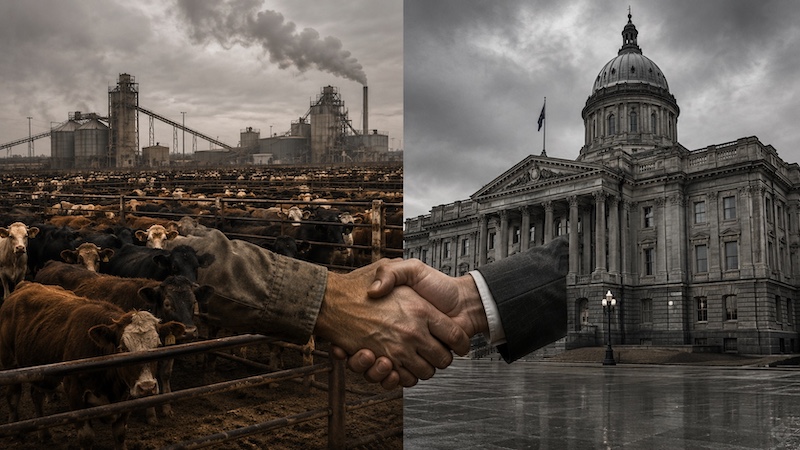
I’ve been in enough vegan spaces to know the reflex.
Someone points out that animal agriculture exists because profit motive exists, and the conclusion lands like it’s self-evident: capitalism is the root cause, and anyone defending markets is defending the slaughterhouse.
I don’t think that’s wrong, exactly.
I think it’s aimed at the wrong target.
What we’re living under isn’t a free market.
It’s corporatism.
And there’s a reason that word should make you uncomfortable.
Mussolini Had a Name For This
Benito Mussolini’s economic model for fascist Italy was called corporatism.
A system in which the state and large industry interests merge; with government power used to protect established industries from competition, manage labour, and direct economic outcomes in the interest of the powerful rather than the public.
He described it as the third way between liberal capitalism and communism.
The state wouldn’t own the means of production, industry would.
The state would just make sure industry got what it needed to keep operating.
Sound familiar?
The animal agriculture industry in Australia receives hundreds of millions in direct government support annually.
Levies matched by government funding, export market development, R&D subsidised by taxpayers, and regulatory frameworks written with heavy industry input.
The United States spends tens of billions on farm subsidies annually, with the overwhelming share going to commodity crops fed to livestock and to meat and dairy producers directly.
That’s not a free market.
That’s corporatism.
Industry and state, working together to insulate a sector from the market pressures that would otherwise reshape or end it.
What a Genuine Free Market Would Do to Animal Agriculture
Here’s the argument vegans are leaving on the table by attacking markets rather than corporatism.
Animal agriculture’s financial viability depends entirely on externalising costs.
The industry does not pay for:
- The water it consumes and contaminates
- The greenhouse gas emissions it produces
- The public health costs of antibiotic resistance driven by routine livestock use
- The land degradation caused by overgrazing
- The healthcare burden associated with high red and processed meat consumption
If a genuinely free market operated, one where businesses bore the real costs of their operations, where subsidies didn’t exist, where externalities were priced in, animal agriculture would face a cost structure that plant-based food systems don’t.
Legumes don’t require the same water inputs.
They don’t produce methane.
They don’t drive the same antibiotic resistance risk.
The economics, unmanipulated, favour plants.
That’s not an ideological claim.
It’s a cost accounting observation.
The reason we don’t see the market deliver that outcome is precisely because the market isn’t free.
It’s managed.
Managed in the interest of an industry that has been politically powerful since the agricultural revolution and that has, in the modern era, mastered the art of regulatory capture.
The Subsidy Is the Argument
When vegans argue that capitalism is the problem, the implicit claim is that the profit motive itself produces animal agriculture.
The profit motive in a genuinely competitive environment would chase the cheapest protein production method available.
Right now, that’s increasingly not animal agriculture.
The reason the transition isn’t happening faster isn’t the profit motive.
It’s that the profit motive is being artificially constrained by a system of subsidies, regulatory protection, and political influence that keeps an uncompetitive industry on life support.
Remove the subsidy.
Price the externality.
Get the state out of the arrangement it struck with the meat and dairy sector decades ago.
That’s not a defence of capitalism as an ideology.
It’s a recognition that what we’re fighting isn’t markets, it’s the perversion of markets in the interest of entrenched power.
And that perversion has a name.
Mussolini named it himself.
Why This Matters Strategically
Attacking “capitalism” as the root cause of animal agriculture closes off a coalition that could otherwise accelerate change.
There are fiscal conservatives, libertarians, and small-government advocates who are genuinely opposed to agricultural subsidies on principle.
Some of them eat meat.
Some of them might stop, or vote differently on agricultural policy, if vegans made the argument on economic grounds rather than ideological ones.
“The government is propping up an industry that would otherwise shrink under market pressure” is an argument that lands differently than “capitalism is the enemy.”
The first invites people in.
The second tells half the potential coalition to leave before you’ve made your case.
We don’t have to agree on everything to agree that the taxpayer shouldn’t be funding the slaughterhouse.
The Real Enemy Is Captured Government
I’m not writing this to rehabilitate capitalism or to argue that free markets are a neutral force for good.
Markets embed power, and power is rarely distributed fairly.
That’s a real and important critique.
I’m writing this because precision matters.
When we say capitalism is the enemy, we let the actual mechanism off the hook.
The actual mechanism is a government that has, for generations, chosen to use public money and regulatory power to prevent an industry from facing the consequences of its own inefficiency and harm.
That’s the fight.
And it’s one we can win if we name it correctly.