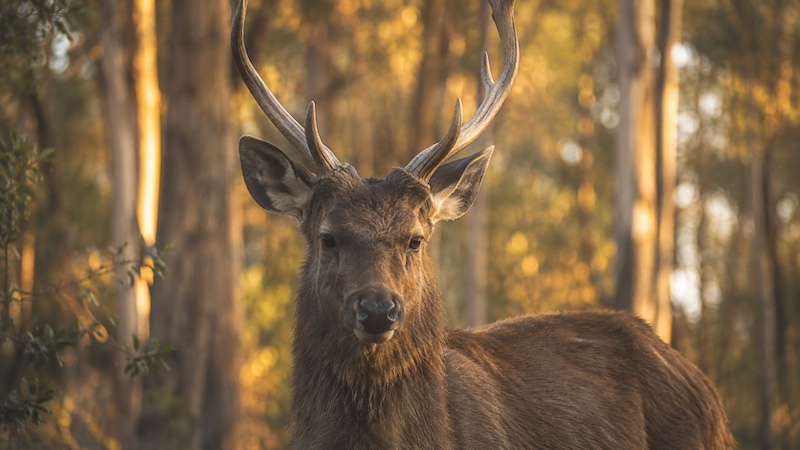
There’s a war being fought in Victoria over deer.
On one side, the Invasive Species Council wants them reclassified, delisted, and killed at scale.
On the other, the Sporting Shooters Association of Australia wants hunting culture and public land access protected.
Both sides are generating press releases, trading accusations of bad faith, and invoking science, economics, and democratic legitimacy.
Neither side is asking whether any of this is actually okay with the deer.
That omission is the whole story, as far as I’m concerned.
The SSAA Victoria recently published a piece dismantling claims made by the Invasive Species Council, specifically that hog deer are “overrunning” eastern Victoria and that game status protects deer from necessary “management”.
Some of their factual rebuttals are reasonable.
What struck me reading it wasn’t the dispute between the two organisations.
It was how completely both sides share the same foundational assumption.
Animals are resources.
The only argument is about who gets to kill them.
The Language That Makes Killing Invisible
Let’s start with the language, because the language never lies.
The article talks about harvest.
About management.
About control.
About populations being overabundant.
These words don’t describe a living creature with a nervous system, a social structure, and an interest in not being shot.
They describe inventory.
They describe a logistics problem.
The entire policy debate is conducted in the language of resource management, and that language is doing serious moral work, it makes the killing invisible by making the animal invisible.
“Harvest” is what you do to wheat.
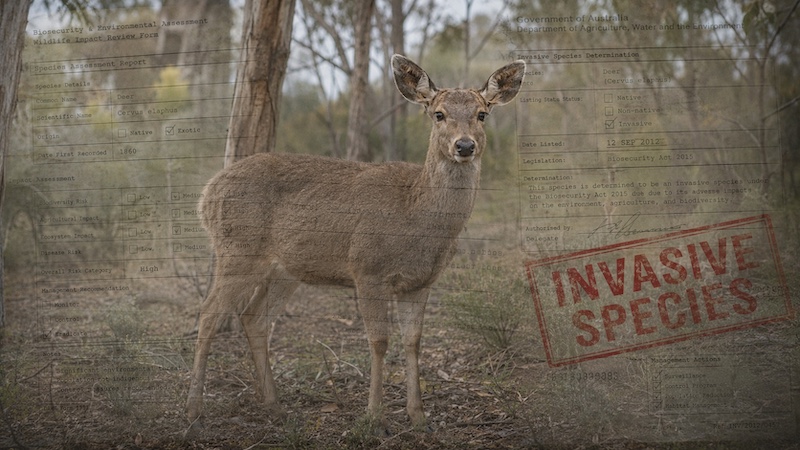
The Invasive Species Label Is Doing a Lot of Work
The label “invasive species” performs a similar function, and it deserves more scrutiny than it usually gets.
Deer didn’t arrive in Victoria of their own accord.
They were introduced by humans, for hunting.
That’s worth sitting with.
The animals were brought here deliberately, by the same culture that now classifies them as a problem.
They have been in this landscape for generations.
They have behaviours, ranges, social bonds.
And now, because human priorities have shifted, they are “invasive”, a word that strips them of any moral standing and reframes their existence as a kind of trespass.
The invasive species label is extraordinarily useful if you want to kill animals at scale without public discomfort.
It relocates blame from the humans who made the original decision to the animals themselves.
It makes culling sound like correction.
It turns the victim of a human choice into the cause of a human problem.
A sambar deer in Sri Lanka is wildlife.
The same animal in Victoria is a pest.
The animal didn’t change.
The bureaucratic category did.
What “Protection” Actually Means Here
What the SSAA piece reveals, unintentionally, is that “protection” for animals in this framework means something very specific.
Hog deer, we’re told, are “internationally significant,” “highly valued,” and worthy of careful management rather than open slaughter.
The reason?
They’re “highly valued as a game species.”
Read that again.
The protection being offered is not protection from being killed.
It’s protection so that the right people can kill them in the right way, under the right administrative framework.
The value attributed to hog deer is their value as targets.
Their “significance” is measured entirely by human recreational desire.
This is what passes for conservation in a culture that cannot imagine animals having interests of their own.
Now Let’s Talk About Money
The SSAA does, at length.
The piece cites an estimated $201 million in annual economic contribution from deer hunting, supporting more than 1,700 jobs, “overwhelmingly in regional communities.”
These figures are presented as a reason why deer hunting deserves policy protection.
The implicit argument is straightforward: this activity is economically significant, therefore it warrants institutional support.
I want to take that argument seriously, because it’s the kind of argument that actually moves policy.
And taking it seriously means asking the question the SSAA never asks.
Compared to what?
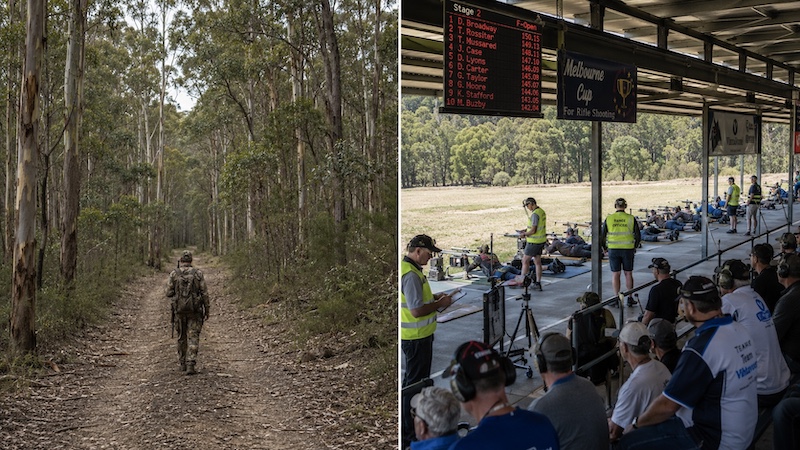
The $201 million is generated by approximately 47,000 hunters operating across what Parks Victoria estimates at around eight million hectares of public land.
That’s an enormous geographic footprint producing dispersed economic activity, fuel stops, regional motels, camping gear, ammunition purchased weeks before the trip.
The land itself generates nothing.
It’s a backdrop, not an asset.
Nobody builds anything.
Nobody employs a chef.
Nobody hosts a three-day international competition.
Consider a different scenario entirely.
A purpose-built competitive shooting complex, covering handgun disciplines like practical pistol and target pistol, alongside long-arm disciplines like precision rifle and benchrest, operating year-round on a few dozen hectares of land, could plausibly generate comparable economic returns at a fraction of the footprint.
And without requiring the death of anything.
Competitive shooting facilities concentrate spending.
Range fees, coaching, retail, food and beverage, accommodation partnerships, all of it flows through a single location with infrastructure, staff, and recurring revenue.
It doesn’t depend on seasonal conditions, wildlife population estimates, or policy settings that can shift with a change of government.
Competition events are tourism multipliers in a way that a lone hunter camping in state forest simply isn’t.
A national precision rifle championship or practical pistol series draws interstate competitors who travel specifically for the event, stay for multiple days, and spend consistently.
A single major weekend with 400 competitors spending $800 each in the surrounding region generates $320,000 in direct visitor expenditure.
Run twenty events a year and the numbers become significant, concentrated, measurable, and attributable to a specific facility rather than dispersed invisibly across millions of hectares.
Then there’s the equipment spend, which the SSAA’s economic modelling presumably counts as a feature of hunting culture, which applies equally, and arguably far more intensively, to competitive shooting.
A serious precision rifle competitor will routinely spend $5,000 to $15,000 on a single rifle setup, before optics.
Benchrest shooters and practical pistol competitors are similarly equipped.
The average deer hunter, by contrast, may use the same rifle for decades.
The per-head equipment spend in competitive shooting disciplines substantially exceeds that of recreational hunting.
If economic contribution through the firearms and optics industry is the measure, the competitive shooter is a significantly more valuable participant than the hunter, and they don’t need eight million hectares of public land to do it.
Add year-round membership revenue, casual range use, coaching programs, and retail, a well-run major facility could reasonably generate $8 to $12 million annually and support 20 to 40 direct full-time equivalent positions, plus event staff.
From a single facility on land you could fit inside a suburban postcode.
So Why Doesn’t the SSAA Make This Case?
That question is worth sitting with.
The SSAA operates its own network of ranges across Victoria.
A world-class purpose-built competitive facility, properly funded, professionally managed, capable of hosting national and international events, would not complement that network.
It would compete with it.
It would draw members, revenue, and institutional prestige away from existing infrastructure the SSAA controls.
There is also something more structurally uncomfortable to consider.
In Victoria, as in most Australian states, firearm licence holders in certain categories are required by legislation to maintain genuine membership of an approved shooting club.
The SSAA is the dominant such organisation.
That means a significant portion of the SSAA’s membership base exists not because members chose SSAA in an open market.
They do so because the licensing regime created a captive audience.
Remove the legislative requirement and it is genuinely unclear how many members would remain.
This matters because the SSAA speaks loudly about representing 22,000 Victorian members.
Except an organisation whose membership numbers are substantially underwritten by government regulation is not the same thing as one that has earned that constituency through market competition.
It has a structural interest in maintaining the regulatory settings that sustain it, including game status for deer, which keeps hunters in the field, keeps them licensed, and keeps them paying membership fees to organisations like the SSAA.
That is not a conspiracy.
It is a conflict of interest.
And a significant one.
It means that when the SSAA makes economic arguments about deer hunting, those arguments should be read not as neutral analysis but as the output of an organisation with considerable institutional skin in the game, one that has perhaps more reason than most to avoid asking what a genuine economic comparison might actually reveal.
The SSAA claims it represents both hunters and competitive shooters.
Those are not the same constituency with the same interests, even if they share a membership organisation.
Competitive shooting generates equivalent equipment spending, similar regional tourism, and comparable community engagement.
The rifles, optics, and ammunition still get purchased.
The sport still happens.
The animal just doesn’t die at the end of it.
If the economic argument for deer hunting specifically, rather than shooting sport generally, were examined honestly, it would be considerably weaker than the SSAA’s figures suggest.
The $201 million is an argument for the shooting community.
It is not obviously an argument for hunting as the activity that community must be centred around.
The SSAA almost certainly knows this. Which might explain why the comparison is never invited.
47,000 Hunters and the Limits of Democratic Legitimacy
The piece cites 47,000 licensed deer hunters in Victoria, roughly one in five firearm licence holders, and presents this as democratic legitimacy for current policy settings.
And from inside the mainstream wildlife debate, that’s a reasonable point.
Numbers matter in a democracy.
But majority preference has never been a strong moral foundation, particularly on questions of harm to those who can’t vote, can’t lobby, and can’t publish press releases.
The deer aren’t represented in this conversation.
Their interests are not a variable in the economic model.
47,000 hunters create a constituency.
The deer don’t.
That asymmetry is treated as natural and unremarkable, when it is neither.
Both Sides Are Proposing the Same Thing
I want to be careful not to simply swap one set of human priorities for another.
The ISC’s position, reclassify, delist, kill at scale, is not better for the deer.
It is arguably worse.
The SSAA’s critique of the eradication fantasy is actually the more honest assessment of what “ambition, funding and focus” would mean in practice: an industrialised killing program of enormous scale across millions of hectares.
Both sides, when you strip the policy language away, are proposing mass killing.
They differ on methodology, on who holds the rifle, and on what paperwork is required beforehand.
They agree entirely on the outcome.
What an Honest Conversation Would Actually Look Like
The SSAA piece ends with a call for “honest conversations about wildlife management”.
I’d like one of those too, though I suspect it would look very different from what either organisation has in mind.
An honest conversation would acknowledge that deer are not inventory.
That “management” is a euphemism.
That the invasive species classification exists partly because it makes large-scale killing politically easier to sell.
It would also apply the SSAA’s own standards consistently.
The piece demands rigorous evidence before accepting the ISC’s population claims about deer.
That’s fair.
Let’s ask how carefully those same standards are applied when the conversation turns to the millions of native kangaroos killed annually under population estimates that wildlife scientists have repeatedly contested.
Kangaroos aren’t introduced.
They aren’t invasive.
The “overabundant” label is doing identical work, and the scrutiny is notably absent.
An honest conversation would ask what a genuine accounting of economic contribution looks like, not just the gross figure, but the comparison with what else that land and that community of skilled, equipped, enthusiastic people could produce without the killing being the point of the exercise.
And most of all, it would ask the question that neither press release comes close to asking.
What do we actually owe to the animals who are here, right now, through no fault of their own, having been introduced by us, having adapted and survived and built lives in a landscape we’ve decided they don’t belong in?
That question won’t resolve the deer debate.
Until it’s part of the conversation, we’re not having an honest one.
Got thoughts on this?
I’d genuinely like to hear them, including if you disagree.
Drop a comment below.